
Filler can refine the profile and camouflage irregularities in the nose. It cannot reduce size, and it carries more risk than any other filler site.


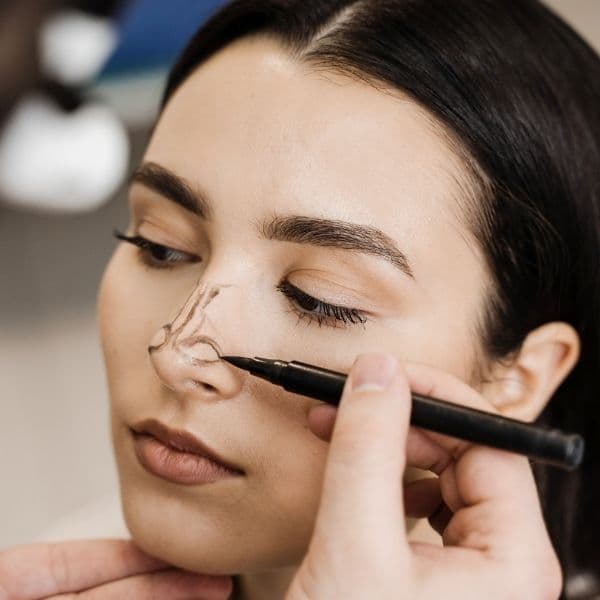
Non-surgical rhinoplasty uses small amounts of firm hyaluronic acid filler to change the contour of the nose. It can smooth a dorsal hump by building either side of it, lift a drooping or under-projected tip, straighten the appearance of a slightly deviated bridge, or correct asymmetry.
What it cannot do is make a nose smaller. Filler adds; it does not remove. A patient whose concern is size needs surgery, and no amount of careful injecting changes that.
At Dr Ellie Sateei’s London and Sevenoaks clinics this treatment is offered selectively, because the nose carries the highest vascular risk of any filler site. Results vary between individuals.
A firm, structural product is placed in very small volumes at specific depths, usually on the bridge and sometimes at the tip or base. Because the nose has limited soft tissue and a dense, relatively closed vascular supply, both the volume and the plane are tightly constrained.
The risk that matters here is vascular occlusion, where product enters or compresses a vessel. In the nose this can affect the blood supply to the skin and, rarely but seriously, to the eye. That risk is managed through anatomical knowledge, aspiration and slow injection, small volumes, appropriate product choice, and having hyaluronidase available to reverse the filler immediately if needed.
Dr Sateei also assesses the chin in profile before treating the nose, because a nose that appears prominent is sometimes a chin that sits back, and improving chin projection can achieve what the patient wanted with less risk.
Previous surgical rhinoplasty, previous filler in the nose, or a history of nasal trauma all change the risk profile and are discussed in detail.
It may suit you if you are looking to:
It is not the right treatment if you want a smaller nose, if you have significant breathing difficulty, or if the change you want is beyond what a few tenths of a millilitre can achieve. It is generally avoided after surgical rhinoplasty where scar tissue has altered the blood supply, and Dr Sateei may decline on that basis alone.
As an injectable treatment, it is not recommended during pregnancy or breastfeeding.

Numbing cream is applied. Treatment takes around 30 minutes and most patients describe pressure rather than sharp pain.
Mild swelling and occasional bruising are common and typically settle within a few days, with the result reading final at around two weeks. Most patients return to normal activities immediately, though glasses and anything pressing on the bridge should be avoided for the first day or two.
Results generally last twelve to eighteen months. You will be given clear aftercare instructions and told exactly what to look out for and who to contact, because the warning signs in this area matter and prompt action is what makes them manageable.
Benefits of non-surgical rhinoplasty
| Treatment | London | Sevenoaks |
|---|---|---|
| Nose filler | From £695 | From £695 |
| Chin fillers | From £650 | From £595 |
| Filler dissolving | From £350 | From £350 |
New patient consultation, £195 at both clinics. If you go ahead with treatment on the day of your appointment, this fee is deducted from the cost of your treatment.
Prices correct as published and subject to change.

“This is the treatment where I am most likely to send someone away, and where I spend the longest explaining why. The nose is unforgiving anatomically, and it cannot be made smaller with filler no matter how skilfully it is placed. I also check the chin first, because a good number of patients who dislike their nose have a chin that sits back, and that is a safer treatment with a bigger effect.”
Dr Ellie Sateei has over two decades of experience in dermatology and aesthetics.
From £695 at both clinics. Your consultation is £195, deducted from the cost of treatment if you go ahead on the day.
No. Filler adds volume and cannot remove it. If size is your concern, surgery is the only route, and Dr Sateei will tell you that rather than treating.
Generally twelve to eighteen months.
The nose carries the highest vascular risk of any filler site. That risk is managed through small volumes, careful placement, appropriate technique and having hyaluronidase immediately available. It is not a treatment to have from an inexperienced injector.
Often not. Scar tissue alters the blood supply and raises the risk considerably. This is assessed individually and Dr Sateei may decline.
Yes. Hyaluronic acid can be dissolved with hyaluronidase, including immediately during treatment if required.
Treatments of interest to book alongside non-surgical rhinoplasty


Non-surgical rhinoplasty can refine a profile and cannot reduce a nose, and it carries more risk than any other filler treatment. The most useful next step is an honest conversation about what is achievable and whether it is the right route for you, including whether the chin is a better place to start. Dr Ellie Sateei sees patients at her London clinic.
Our London clinic is located at 91a New Cavendish Street, London, W1W 6XF
We serve patients from London, Kent and the home counties as well as from all over the world. Our London clinic sits in the heart of Marylebone, within easy reach of the West End by tube, while our Sevenoaks clinic in Ightham is moments from the M25 and M26 for patients across Kent.