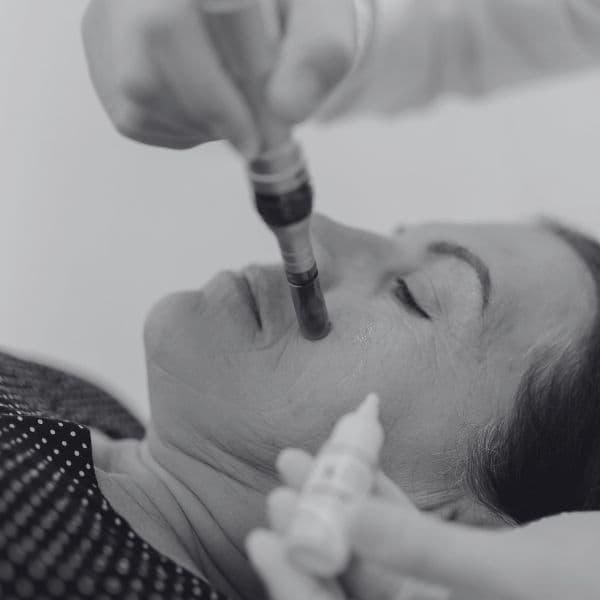
Exosomes deliver the signalling molecules that skin cells use to coordinate repair, applied while the skin’s own repair response is already active.


Exosomes are very small vesicles that cells use to send signals to one another. They carry proteins, growth factors and genetic messengers, and in the skin those signals help coordinate repair, inflammation control and collagen production.
Exosome therapy delivers a concentrated preparation of those signalling molecules into skin that is already repairing. It is not a filler and not an injectable volumiser. It works by influencing how the skin behaves rather than by adding anything structural.
At Dr Ellie Sateei’s London clinic exosomes are applied following microneedling, when the channels created during treatment allow absorption and the repair response is already switched on. Results vary between individuals.
Microneedling creates thousands of microscopic channels and triggers a repair cascade. Applying exosomes immediately afterwards puts the signalling molecules into skin that is receptive and already rebuilding.
The intended effect is twofold: a calmer, faster recovery from the procedure itself, and a stronger collagen response than the procedure would produce alone. Patients typically describe less redness for less time, and skin that looks better sooner.
Two things are worth being straightforward about. First, the evidence base for exosomes in aesthetics is younger than for hyaluronic acid or polynucleotides. The mechanism is well described and the early clinical data is encouraging, but this is a newer field and anyone claiming certainty is overstating it. Second, the products differ considerably in source, concentration and preparation, and regulatory status in the UK varies. Dr Sateei selects from products she is satisfied with and will explain what she is using and why.
Exosomes are an addition to a treatment, not a treatment on their own. Applied to intact skin without a procedure to open absorption, very little of the benefit is available.

It may suit you if you are:
It is not a standalone treatment, not appropriate during pregnancy or breastfeeding, and not the right route if what you want is a structural change. Where an established regenerative option with a longer evidence base would serve you as well, Dr Sateei will say so, and polynucleotides frequently fall into that category.

Exosomes are applied to the skin immediately after microneedling. The application itself is comfortable and adds only a few minutes to the appointment.
There is no separate downtime beyond that of the accompanying treatment. Most patients notice the skin looks calmer and less red in the days afterwards than they would expect from microneedling alone.
Skin quality improvements build over the weeks following, in line with the collagen response of the accompanying treatment rather than on their own timeline.
| Treatment | London | Sevenoaks |
|---|---|---|
| Exosome therapy, added to microneedling | TBC | TBC |
| Microneedling | TBC | From £350 |
New patient consultation, £195 at both clinics. If you go ahead with treatment on the day of your appointment, this fee is deducted from the cost of your treatment.Prices correct as published and subject to change.
“I like exosomes and I am not going to pretend the evidence is as mature as it is for polynucleotides. What I can say is that the mechanism makes sense, the early data is encouraging, and patients recover more comfortably from microneedling with them than without. That is a reasonable thing to offer somebody. What is not reasonable is the way they are being oversold elsewhere on the strength of the word alone.”
Dr Ellie Sateei has over two decades of experience in dermatology and aesthetics.
Pricing is confirmed at consultation, which is £195 and deducted from treatment on the day. Exosomes are added to microneedling rather than charged as a standalone treatment.
Very small vesicles that cells use to signal to one another, carrying proteins and growth factors that help coordinate repair and collagen production in the skin.
Not usefully. They need a procedure such as microneedling to open absorption, otherwise very little of the benefit is available.
The mechanism is well described and early clinical data is encouraging, but this is a younger field than hyaluronic acid or polynucleotides. Dr Sateei will be straightforward with you about that.
Both are regenerative. Polynucleotides have a longer track record and their own published prices here. Exosomes are applied topically during a procedure rather than injected as a course.
No. There is no separate downtime beyond that of the accompanying treatment, and most patients recover more comfortably rather than less.
Exosome Therapy is often planned alongside these.


Exosomes support the repair response microneedling begins, and they are an addition to a treatment rather than a treatment alone. If you are considering them, an assessment will set out honestly what the evidence supports and whether polynucleotides would serve you better. Dr Ellie Sateei sees patients at her London clinic.
Our London clinic is located at 91a New Cavendish Street, London, W1W 6XF
We serve patients from London, Kent and the home counties as well as from all over the world. Our London clinic sits in the heart of Marylebone, within easy reach of the West End by tube, while our Sevenoaks clinic in Ightham is moments from the M25 and M26 for patients across Kent.