Collagen stimulators work differently to filler. Rather than adding volume, they prompt your own skin to rebuild its collagen, so firmness returns gradually.


Collagen stimulators, sometimes called biostimulators, are injectable treatments that prompt the skin to rebuild its own collagen rather than adding volume directly. The improvement comes from your own tissue, which is why it develops over months rather than appearing at the appointment, and why it tends to read as better skin rather than as treatment.
They are the appropriate answer where the dominant change is thinning, laxity and loss of firmness rather than a specific hollow. At Dr Ellie Sateei’s London clinic a range of biostimulators is used, selected according to the area, the degree of laxity and how quickly you would like to see change. Results vary between individuals, and patience is part of the treatment.

All biostimulators work on the same principle and differ in their material, their speed and how much immediate structure they provide.
Once injected, the product acts as a scaffold that prompts a controlled response from your fibroblasts, the cells that manufacture collagen. Over the following weeks and months those cells lay down new collagen around the scaffold. The product itself is gradually broken down and absorbed, leaving the collagen behind. What you are left with is your own tissue, which is the essential difference from filler.
The main materials differ meaningfully:
Which of these suits you depends on the area, the tissue quality and your timeline. Dr Sateei will explain her reasoning, and will decline where a biostimulator is not the right tool. Notably, most biostimulators are not appropriate near the eyes or in the lips.
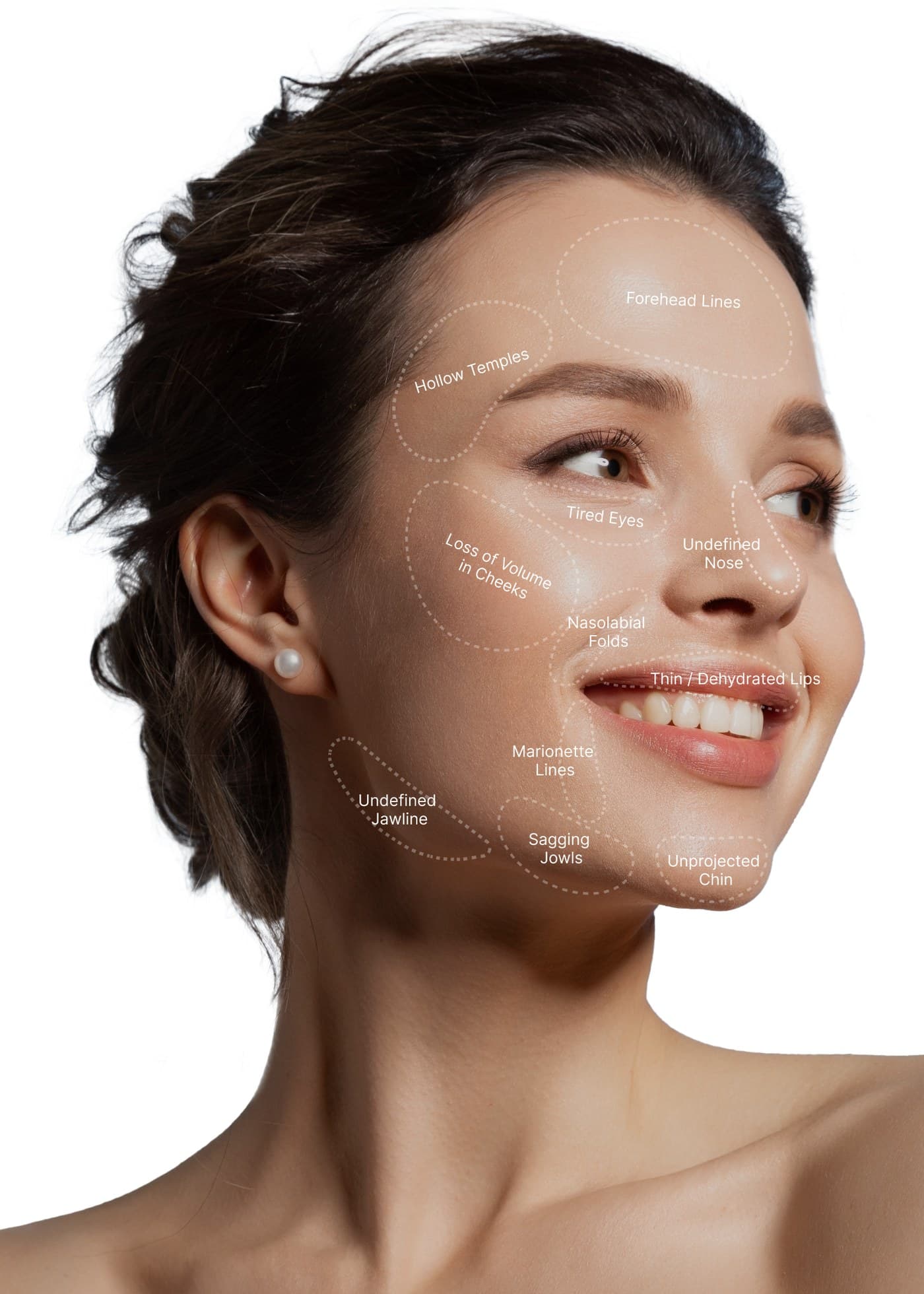
Collagen stimulation may suit you if you are looking to:
It is usually not the right choice if you need visible improvement before an event in the next few weeks, as the meaningful change takes months. It is also not the right choice where a specific hollow needs filling, in which case a dermal filler is more precise. It is generally avoided in the tear trough and the lips.
As with any injectable, it is not recommended during pregnancy or breastfeeding. Autoimmune conditions, a history of granulomatous reaction and any previous filler in the area will be discussed at consultation, because biostimulators are not reversible in the way hyaluronic acid fillers are. That is the single most important thing to understand before proceeding, and Dr Sateei will make sure you do.

Treatment usually takes around 30 minutes, depending on the area. Local anaesthetic or numbing cream is used, and most products are mixed with lidocaine for comfort. Temporary redness, swelling or minor bruising at injection sites is common and usually settles within a few days. Some products require post-treatment massage of the area and some specifically do not, and you will be given clear instructions for the product used.
Treatment is generally planned as a course of two to three sessions spaced a few weeks apart, so collagen can build between them.
Results build progressively. Where a product provides immediate structure you may see some change straight away, but this is not the result; it settles within a fortnight and the real improvement follows as collagen forms over three to six months. Depending on the product and area, results may last from twelve to eighteen months up to two to three years.
| Treatment | London | Sevenoaks |
|---|---|---|
| Radiesse, collagen-stimulating treatment | From £690 | From £690 |
| Juläine, 2 sessions | From £1,885 | From £1,885 |
New patient consultation, £195 at both clinics. If you go ahead with treatment on the day of your appointment, this fee is deducted from the cost of your treatment.
Prices correct as published and subject to change.
“Biostimulators are the treatments I find myself explaining most, because patients arrive expecting filler and what I’m offering works in the opposite direction. Nothing much happens for weeks, and then your skin starts producing its own collagen and the change creeps up on people. The trade-off is honesty about two things: it takes months, and unlike hyaluronic acid I can’t dissolve it. So I only use it where I’m confident it’s the right answer.”
Dr Ellie Sateei has over two decades of experience in dermatology and aesthetics.
A filler adds volume immediately by occupying space. A collagen stimulator prompts your own skin to build collagen over months, so the improvement is your own tissue rather than an injected product.
Depending on the product and area, from twelve to eighteen months up to two to three years. Results vary between individuals.
Some products give immediate structure, but that settles within a fortnight. The genuine improvement develops as collagen forms over three to six months.
No. Unlike hyaluronic acid fillers they are not reversible, which is why the assessment beforehand matters so much.
It depends on the area, the tissue quality and how quickly you would like to see change. This is a clinical decision made at consultation, and Dr Sateei will explain her reasoning.
Usually two to three, spaced a few weeks apart so collagen can build between them. Juläine is priced as a course of two at £1,885.
Collagen Stimulation treatments are often planned alongside these.



Collagen stimulators rebuild firmness using your own collagen, which takes months and cannot be reversed. If your skin has softened rather than hollowed, an assessment will establish whether that trade-off is the right one for you, and filler or a skin booster is frequently the better answer. Dr Ellie Sateei sees patients at her London clinics.
Our London clinic is located at 91a New Cavendish Street, London, W1W 6XF
We serve patients from London, Kent and the home counties as well as from all over the world. Our London clinic sits in the heart of Marylebone, within easy reach of the West End by tube, while our Sevenoaks clinic in Ightham is moments from the M25 and M26 for patients across Kent.