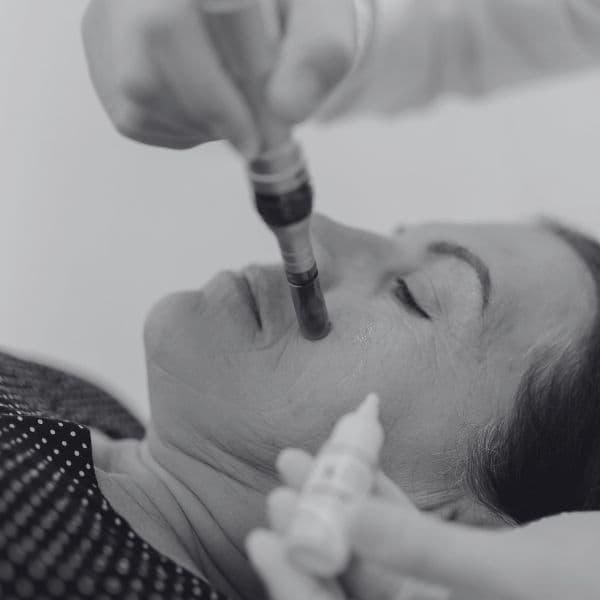
Microneedling prompts the skin to build its own new collagen, improving texture, firmness and quality over a course of treatments.


Microneedling is a medical-grade treatment that creates thousands of tiny, controlled channels in the skin to trigger its natural repair response. That repair is what produces new collagen and elastin, and it is why the treatment improves texture and firmness rather than simply resurfacing the top layer.
At Dr Ellie Sateei’s clinic, microneedling is performed with SkinPen, a medical-grade device, and planned as a considered course rather than a single appointment. It rewards patience. Results build over months rather than appearing after one session, and results vary between individuals.

SkinPen passes over the skin creating very fine micro-channels at a precisely controlled depth. Your skin registers these as small injuries to repair, and that repair response prompts fibroblasts to produce fresh collagen and elastin, the proteins that keep skin firm and smooth.
Two things make this a clinical treatment rather than a cosmetic one. The first is depth control. The right depth for shallow textural irregularity is not the right depth for boxcar scarring, and getting it wrong means either no result or unnecessary trauma. The second is that no heat or chemistry is involved, which is why microneedling suits a wider range of skin tones than laser resurfacing, with a lower risk of post-inflammatory pigmentation in deeper skin tones.
Because the mechanism is your own collagen response, the improvement is gradual and cumulative. This is also why microneedling combines so effectively with regenerative products. The channels created during treatment allow exosomes or polynucleotides to be delivered into skin that is already primed to repair, and Dr Sateei will discuss whether adding one is worthwhile for your skin.

Microneedling may suit you if you are looking to:
It is usually not the right first step if you have an active skin infection, an ongoing inflammatory flare in the area, or active moderate to severe acne, where the acne itself needs managing first. It is not recommended during pregnancy. If you have a history of keloid scarring, are taking oral retinoids, or have certain autoimmune or clotting conditions, Dr Sateei will discuss this at consultation and may recommend an alternative.

Numbing cream is applied first, so treatment is comfortable for most people, usually felt as a light prickling or vibration. A session takes around 45 minutes to an hour including preparation, depending on the area being treated.
Afterwards you can expect redness and a warm, tight feeling for a day or two, much like mild sunburn. For some people the colour takes three to four days to settle fully. Most patients return to normal activities the next day and can wear mineral makeup after around 24 hours.
Sun protection afterwards is essential rather than optional. Treated skin is temporarily more vulnerable to UV, and neglecting this is the most common reason a course disappoints.
Results are progressive. You may notice a fresher look within the first couple of weeks, but the meaningful improvement in texture and firmness develops as new collagen forms over roughly one to three months. Because of this, microneedling is planned as a short course spaced a few weeks apart, typically three to six sessions depending on the concern, with occasional maintenance afterwards. Acne scarring generally needs more sessions than textural improvement, and results vary between individuals.
“The honest thing about microneedling is that it rewards patience. It is not about one dramatic session, it is about giving your skin the signal to rebuild its own collagen and then letting that work over the following weeks. I plan a course around what your skin actually needs, so the depth and the aftercare are right for you rather than generic. Done properly, it is one of the most reliable ways to improve skin quality without changing how you look.”
Dr Ellie Sateei has over two decades of experience in dermatology and aesthetics.
| Treatment | London | Sevenoaks |
|---|---|---|
| Microneedling | Not currently offered | From £350 |
New patient consultation, £195 at both clinics. If you go ahead with treatment on the day of your appointment, this fee is deducted from the cost of your treatment.
Most patients describe it as tolerable rather than painful. Numbing cream is applied beforehand, so the sensation is usually a light prickling or vibration. Any tenderness afterwards is mild and settles within a day or two.
Typically three to six, spaced a few weeks apart, from £350 per session. Acne scarring generally needs more than textural improvement. Dr Sateei confirms the number at consultation.
Minimal. Expect redness and a warm, tight feeling for a day or two, similar to mild sunburn, occasionally taking three to four days to settle. Most people return to normal activities the next day and can wear mineral makeup after 24 hours.
Yes, for textural scarring. Prompting new collagen may help soften indentations and refine the skin surface over a course. Deeper or older scarring is assessed individually and expectations set accordingly.
It uses no heat or chemistry, which gives it a lower risk of post-inflammatory pigmentation than heat-based resurfacing. Suitability is confirmed at consultation.
Sun exposure without protection, active skincare such as retinoids and acids for a few days, and alcohol, vigorous exercise and extremes of heat for around 48 hours. Full aftercare guidance is set out below and given at your appointment.
Following microneedling with Dr Ellie Sateei, the skin is usually pink and warm,
similar in appearance to mild sunburn. This settles over the following day or two.
What you are recovering from is a controlled injury, deliberately made, and the redness is the visible part of the
repair response the treatment is designed to provoke. Aftercare in the first 48 hours is about not interfering
with it. The skin’s barrier is temporarily interrupted and its absorption is unusually high, which means anything
applied to it reaches further than it normally would. That is useful when the product has been chosen for it and
unhelpful when it has not.
Microneedling creates controlled micro-channels in the skin using a medical-grade device, prompting the skin’s own collagen and repair processes. Results build progressively over the following months as the skin remodels. Aftercare is barrier-first, with a regenerative serum morning and evening to support the repair response while absorption remains elevated. No acids, no retinoids, and rigorous sun protection.
To prepare for your appointment:
On the day, clinical photographs and consent are completed if not already done, and the skin is cleansed and prepared. Topical anaesthetic is applied and left for approximately 20 to 30 minutes. Treatment takes approximately 30 minutes following preparation.
The appearance of the skin in the first 48 hours is expected and is not a complication. You may notice:
Two things are happening at once here, and the protocol answers both. A regenerative serum supports the repair response the needling has provoked, and a barrier repair balm protects the skin surface while the micro-channels close.
| Step | Morning | Evening |
|---|---|---|
| 1 | Calecim Professional Serum | Calecim Professional Serum |
| 2 | iS Clinical Sheald Recovery Balm | iS Clinical Sheald Recovery Balm |
| 3 | Dermaceutic K Ceutic Post Treatment Cream SPF 50 | — |
Day of and day after treatment only: Revision Hydrating Biocellulose Mask, a single mask.
For the first 48 hours:
Sun protection carries the most weight here. Skin in the weeks after microneedling is more vulnerable to pigmentary change, and the treatment is frequently chosen by patients for whom uneven pigment is already a concern.
Some patients maintain their improvement with occasional sessions afterwards. Dr Sateei will discuss whether that is appropriate for you rather than committing you to a schedule in advance.
Microneedling may not be appropriate if you have:
Most skin types and tones are suitable, confirmed following a skin assessment.
Please contact the clinic if you experience:
Microneedling is often planned alongside these.
Microneedling improves texture, scarring and firmness by prompting your own collagen, and it works most reliably planned as a course. If you are considering it, the useful conversation is how many sessions your skin realistically needs, rather than how many come in a package. Dr Ellie Sateei sees patients at her clinic in London.
Our London clinic is located at 91a New Cavendish Street, London, W1W 6XF
We serve patients from London, Kent and the home counties as well as from all over the world. Our London clinic sits in the heart of Marylebone, within easy reach of the West End by tube, while our Sevenoaks clinic in Ightham is moments from the M25 and M26 for patients across Kent.